
Decatur County Criminal Court Cases
Decatur County sits in Tennessee's 24th Judicial District. Circuit Court exercises felony trial jurisdiction after the early stages required by state law. General Sessions Court handles warrants, initial appearances, preliminary hearings, bind-over proceedings, and misdemeanors within its authority. A municipal citation in Parsons, Scotts Hill, or Decaturville belongs to that city's court when it concerns an ordinance or traffic matter. It does not turn the city court into the felony court.
The clerk's criminal file follows the prosecution, not merely the arrest. It may begin with a complaint or warrant, then gain an indictment, motions, hearing entries, a plea or verdict, and a judgment. The charge written at jail intake can change before filing or disposition. For that reason, readers comparing a booking with Decatur County court records should treat the filed count and final judgment as separate checkpoints.
Decatur Court Files at West Main
The practical access point is the Decatur County Courthouse, 22 W. Main Street, Decaturville, TN 38329. Tennessee Courts lists Kelly Harden as Circuit Court Clerk, with a mailing address of P.O. Box 488 and a telephone number of 731-852-3125. Call before travel. Give the defendant's name and approximate year, ask whether the matter lies in Circuit/Criminal Court or General Sessions, and confirm current counter hours, payment methods, copy charges, and whether an older file must be retrieved.
The official Tennessee Courts entry for Decatur County shows the local court context used for a Decatur County case search.
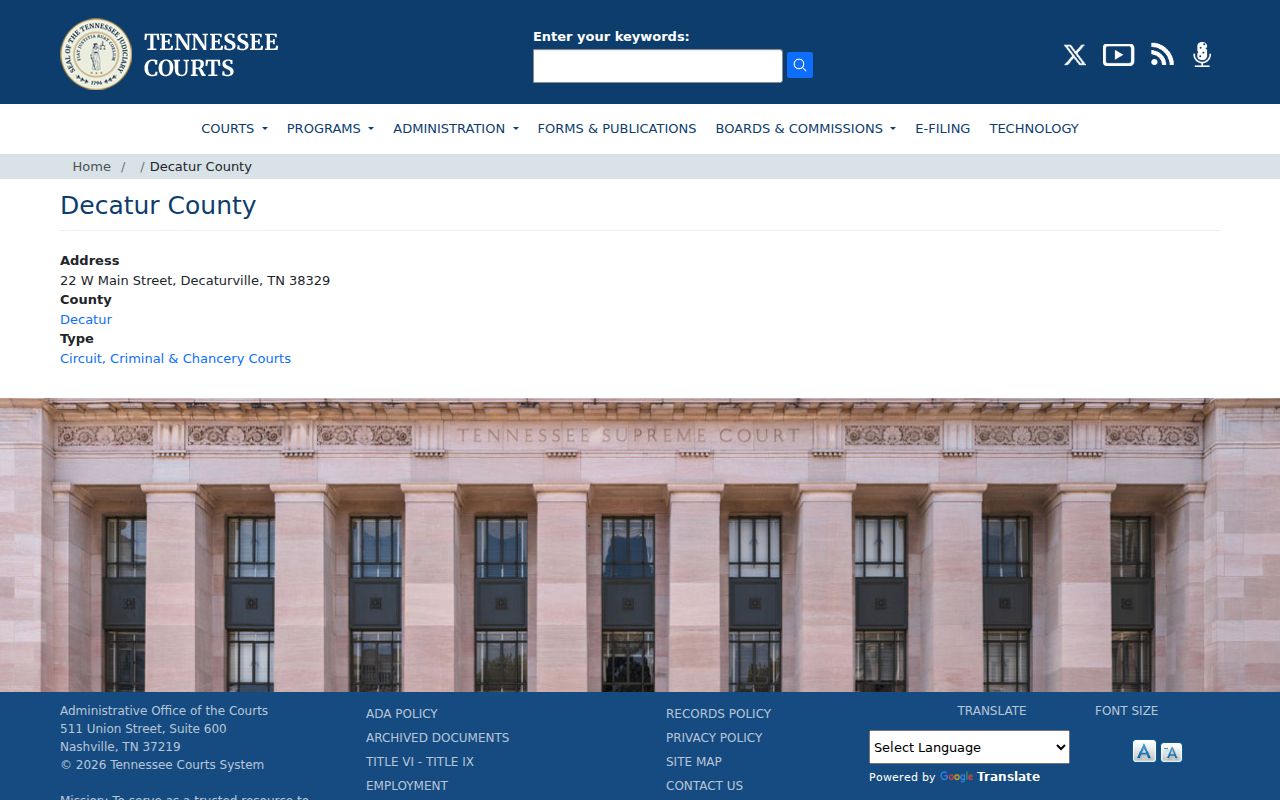
The state entry confirms why the courthouse clerk, rather than an unofficial name-search vendor, is the sound first route to trial-level records.
Searching Decatur County Case Records
No official public Decatur County trial-court name portal was located. A useful search is therefore a direct clerk request, built around identifiers that let staff locate an existing file rather than compile a new history.
- Collect the defendant's exact name, known aliases, approximate arrest or filing dates, and any case or warrant number.
- Call 731-852-3125 and ask which court holds the matter and whether a clerk index search has a charge.
- Request inspection or ordinary copies, state the date range, and say clearly if a certified judgment or disposition is needed.
- Ask whether older Decatur County files are offsite, what retrieval may involve, and which delivery methods the clerk currently accepts.
- Compare the disposition with TORIS, then use appellate Public Case History only when the local docket shows an appeal.
Because the county has no public trial-docket interface, the useful search-field inventory is the set of details supplied to the clerk.
| Search detail | Format | Use | Notes |
|---|---|---|---|
| Defendant name | Full legal name and aliases | Primary index clue | Include middle name when known |
| Case number | Clerk-assigned number | Fastest file match | Read it back to avoid digit errors |
| Date range | Approximate filing or arrest year | Narrows same-name results | Filing can follow arrest |
| Court level | General Sessions or Circuit | Routes the request | Ask the clerk when uncertain |
| Document wanted | Docket, judgment, or certified copy | Defines the response | Certification may cost more |
Decatur Felonies Through District 24
A felony matter usually has an early General Sessions phase before it reaches Circuit Court. General Sessions may handle a warrant, first appearance, bond, and preliminary hearing. A bound-over matter can proceed to the grand jury. A returned indictment then becomes part of the Circuit Court file, followed by arraignment and later events. The District Attorney General for the 24th Judicial District prosecutes for the state, while the clerk preserves what is filed and entered by the court.
This split explains a common blank-result problem. A caller may ask only for a Circuit case even though the matter remains in General Sessions, or may search by arrest date although the court filing came later. Ask the clerk to check the proper court and date frame. City-court matters remain separate unless a state-law criminal case also enters the county system.
Inside a Decatur County Case File
A Decatur County court file is a record of each count and court event. The docket is the chronological register. The charging instrument states what the prosecution alleges. A judgment or disposition shows how a count ended. Those documents answer different questions, so requesting only the first page can omit the later result.
| Case number and court | Identifies the Decatur County division and links documents to one proceeding. |
|---|---|
| Charging document | Shows the complaint, indictment, or information, cited statute, offense class, and counts filed. |
| Docket entries | List hearings, filings, motions, orders, warrants, and other dated court activity. |
| Parties and counsel | Identify the State of Tennessee, defendant, attorneys, and assigned judge where public. |
| Disposition and judgment | Record a plea, verdict, dismissal, acquittal, nolle prosequi, or conviction for each count. |
| Sentence and costs | May show confinement, probation, fines, restitution, costs, and later enforcement entries. |
Note: A dismissal ends that count without conviction, but it does not by itself erase every related arrest or booking record.
Reading Decatur Court Dispositions
Read outcomes count by count. One case can contain a conviction on one charge and a dismissal on another. “Nolle prosequi” means the prosecution formally chose not to continue that count. An acquittal means guilt was not established by the required standard. A disposition is the outcome entry; a sentence is the consequence imposed after a conviction. These terms should not be collapsed into a single “record found” label.
- Arraignment
- The hearing where the accused is told the charge and enters a plea.
- Docket
- The dated register of filings, settings, rulings, and other case events.
- Nolle prosequi
- The prosecution's formal decision not to proceed with a charge.
- Capias
- Court process directing that a person be taken into custody.
- Disposition
- The recorded result of a count or case.
For Decatur County criminal court cases, a certified disposition is often the clearest item for proving the official outcome. Ask whether the certification covers the whole case or one document.
How a Criminal Case Moves
The route depends on the charge and court, but the file grows in a recognizable order. A custodial arrest can create jail records before a prosecutor files a case. Preliminary steps may occur in General Sessions. A felony can then move through the grand jury into Circuit Court. Plea negotiations, motions, or trial produce later docket entries, and an appeal creates a separate statewide appellate trail.
Case flow: Charges Filed › Arraignment › Pretrial › Plea or Trial › Disposition › Sentencing
The clerk record should show the actual path, including missed stages or changes. No county source supports a fixed local timetable, so a reader should use the docket's real dates instead of assuming each Decatur County case follows the same pace.
Decatur Criminal Appeals Online
Tennessee's appellate Public Case History can help only after a Decatur County matter reaches the Supreme Court, Court of Appeals, or Court of Criminal Appeals. It is not a trial-level name search. Start with the local docket and look for an appeal notice, appellate case number, or order that identifies the higher court.
The official Tennessee court-clerk directory helps confirm the Decatur County criminal clerk rather than offering a public docket search.
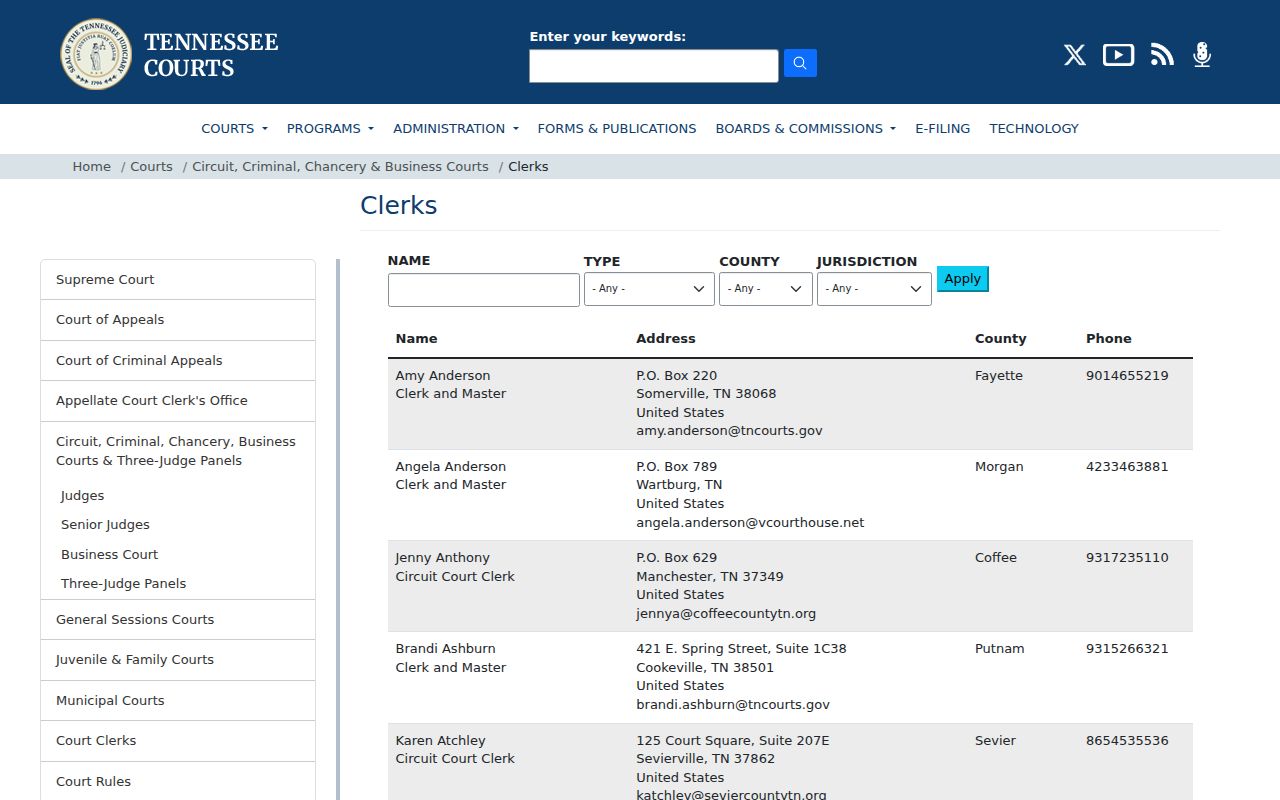
The directory supports clerk contact, while the local file remains the source for pleadings, judgments, and certified trial-court copies.
Archived Decatur Case Record Requests
When a file is old or absent from the current index, ask whether it is archived or stored offsite. Give enough detail to distinguish the case, then ask for an estimate of retrieval time and copying cost. No Decatur County criminal copy fee or archive timetable was published in the research. That makes a pre-request estimate more useful than assuming a statewide price.
The Tennessee Supreme Court Rule 34 access policy provides the judicial-branch framework for court-record requests.
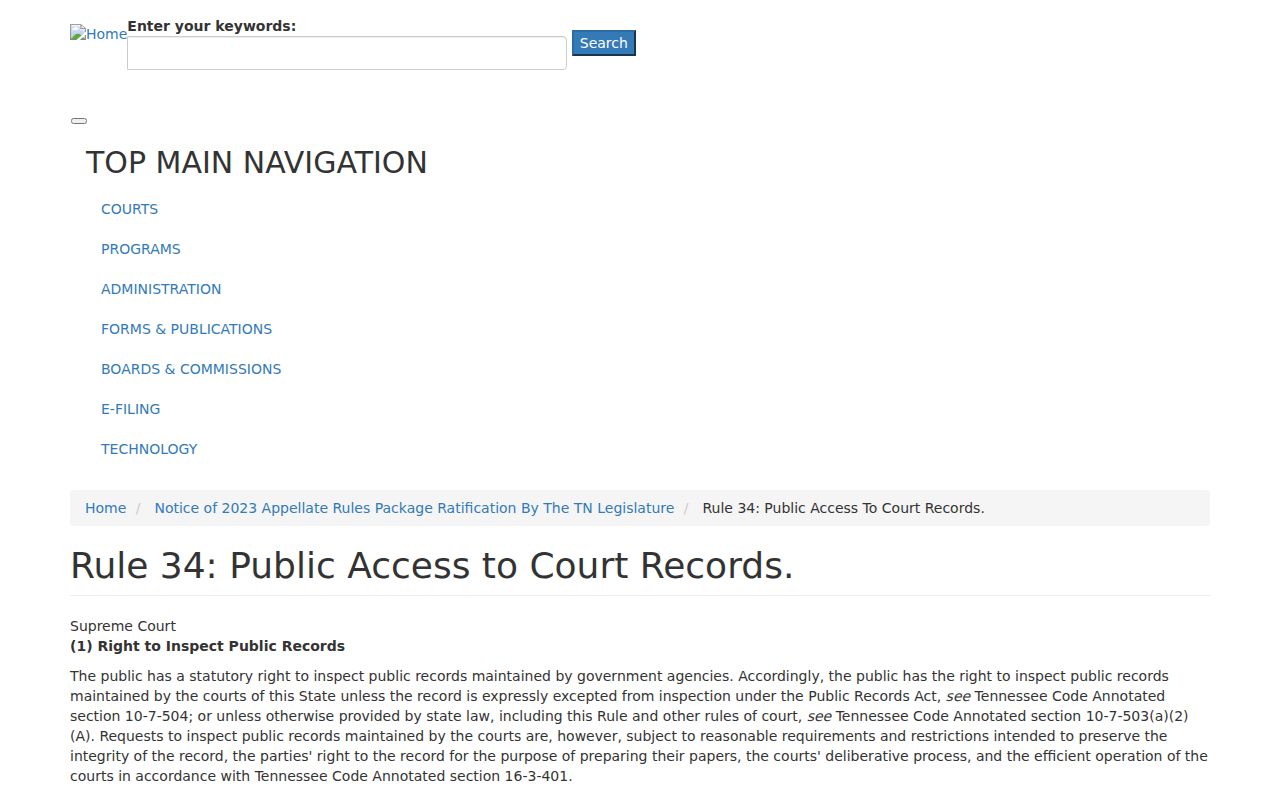
The rule-based request route matters most when a Decatur County file needs review, redaction, retrieval, or a formal response from its custodian.
Case Record Access & Restrictions
Tennessee court records are generally accessible under judicial access policy, but not every item is open in full. Juvenile records, sealed material, protected victim or minor information, Social Security numbers, financial-account data, and medical information can be withheld or redacted. Grand-jury deliberations remain secret even when a returned indictment becomes part of the case file.
If a Decatur County criminal case is missing, ask the clerk whether it is pending under a different court or number, archived, sealed, or affected by expungement. The Tennessee Public Records Act governs state and local executive-branch records, while Tennessee Supreme Court Rule 34 addresses judicial records. Requests should go to the office that maintains the specific record.
A request for a certified judgment should identify the case and the exact document needed. Certification is useful when the reader must establish the court's own outcome, while a plain copy can serve routine personal review. Ask whether all counts appear on one judgment and whether later probation, cost, or capias entries sit elsewhere in the docket. If the public copy has redactions, those marks do not mean the whole file is sealed. They often reflect field-level protections required by Tennessee law.